


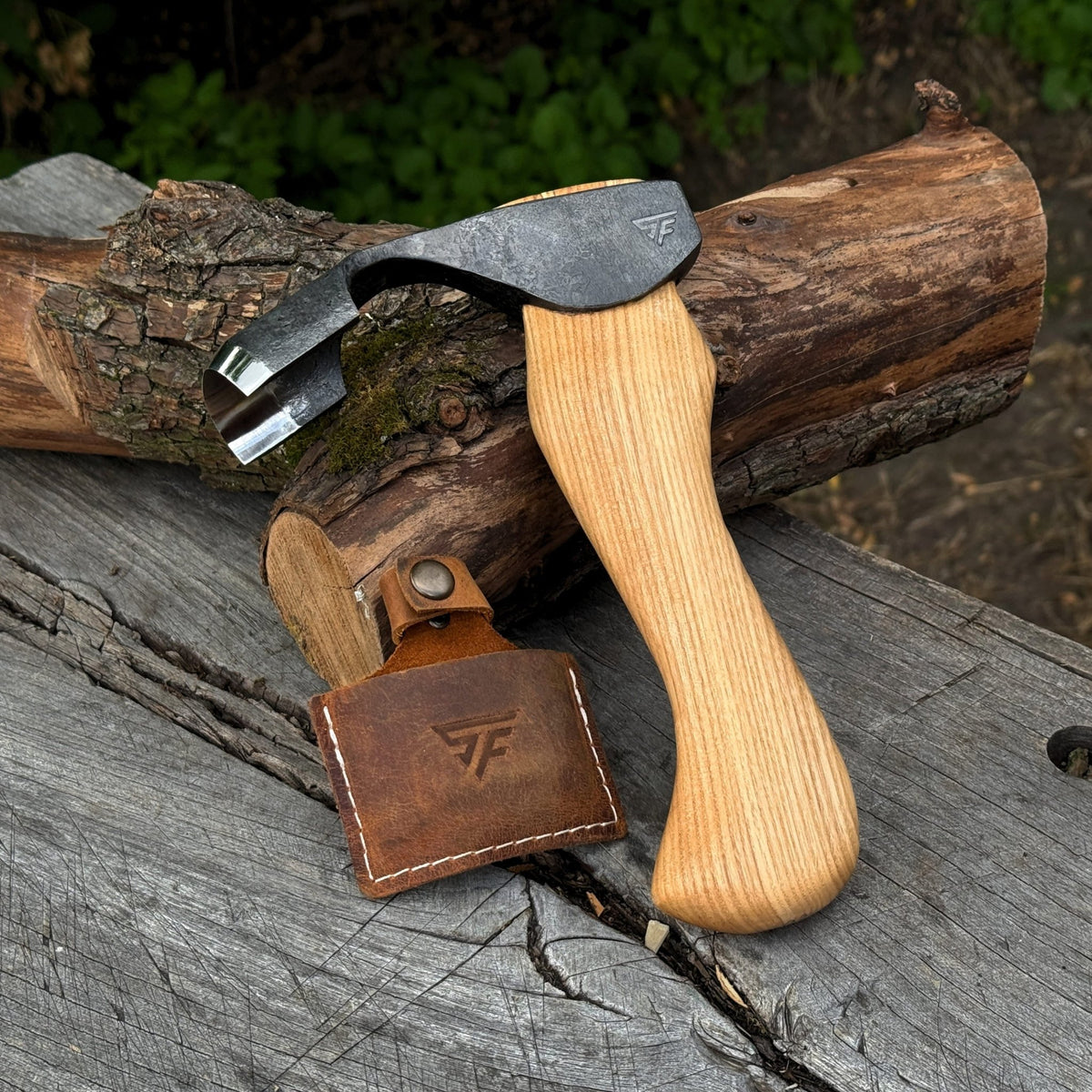
What Can You Do With an Adze
Every woodworking project requires the right equipment, and a hand adze stands out as a true workhorse. So, what is an adze? It is an essential intermediary between raw timber and finished hollow forms. This traditional tool helps remove excess wood and rough-shape heavy logs, so it comes in handy during the first steps of woodworking projects.
Hollowing bowls, spoons, and kuksa cups
Now, what is an adze used for? When you work on a fresh log set on a carving stump, a short-handled bowl adze is one of those bowl carving tools that lets you chop out the hollow. It removes heavy waste and gives the rough recess before you move on to finer gouges and hook knives.
Smaller adzes, or adze-shaped hand gouges, can be used for rough-shaping kuksas and spoons. They take out bulk wood fast and make it easier to shape the natural curves of cups.
Rough shaping and material removal before fine carving
An adze can work like a controlled sculpting axe. A good wood carving adze hacks away bulk in minutes, which saves you hours of exhausting mallet-and-chisel work.
Green wood work — where the adze truly shines
Using an adze on fresh logs lets you cut straight down the center line or along the bark side without needing complex clamping setups.
In the early stages of wood carving, the adze takes care of the heavy work, quickly removing waste and giving you the rough vessel shape before the wood begins to dry.

Types of Adze Blades and What Each One Is For
The design of an adze tells you a lot about what is an adze used for. The shape of the blade and the length of the handle define how the tool performs.
A flat edge gives control, a curved edge makes hollowing easier, and flared corners prevent digging too deep. Knowing these details helps you understand how to use an adze in different stages of a project.
For anyone exploring wood carving tools for beginners, the adze stands out as one of the most versatile tools.
Straight blade — flat surfaces and initial shaping
The straight blade has a flat edge. This adze tool is efficient for roughing out large areas, flattening log tops, and making clean cuts on convex surfaces. The flat edge gives you strong control when steady cutting is needed.
Curved blade — bowls, concave shapes, hollow work
The curved blade, often called a wood carving adze, has a sweeping arc that makes it excellent for hollowing. Its shape allows you to scoop out deep recesses and work across the grain with ease. This design is what makes it the go-to tool for carving bowls.

Lipped blade — spoon carving and grain control
The lipped blade of a carving adze has flared corners that turn upward like wings. These lips stop the edge from biting too deep. It is especially useful when working in tight curves, giving you clean grain control and smooth cuts. For anyone learning how to use an adze, this blade can make precise work less of a struggle.
Adze vs Axe vs Gouge — Which Tool Does What
When you first step into carving, it is easy to get confused about the adze meaning compared to an axe or a gouge. Most confusion can be adze vs axe, since both remove excess wood. The gouge feels more obvious because it comes later for finer shaping.
The blade shape and the way the tool is swung make the difference. For anyone exploring wood carving tools for beginners, understanding these distinctions makes the tool choice a lot easier.
When to reach for an adze instead of an axe
The axe is meant for splitting wood or shaping outer profiles. It works best when you strike across the grain from the outside in. The adze tool comes into play when you move from shaping the outside to hollowing the inside.
When a gouge replaces the adze and vice versa
The adze and gouge overlap in hollowing tasks, but they serve different scales. The carving adze clears large volumes quickly, while the gouge refines details.
Think of the adze as your heavy-duty cutting tool. Once you are close to your final wall thickness, set the adze aside. Pick up a mallet and gouge to smooth tool marks, refine curves, and finish the surface.

Now the difference between axe vs adze work becomes clear: use the adze for hollowing, the axe for shaping from the outside, and the gouge for the fine finishing.
Do You Actually Need an Adze as a Beginner
You may want to hollow green logs with only gouges and mallets. But this approach often leads to sore wrists, blisters, and very slow progress. The best way to avoid burnout is to match your wood carving tools for beginners to the scale of your project right from the start.
If you carve spoons or bowls — yes, here's why
To define adze in plain terms, it is a heavy blade set at a right angle to the handle made for hollowing out wood. A wood carving adze saves a lot of time, especially when it is short-handled.
Instead of forcing small bowl carving tools like gouges, you swing the adze with control from your shoulder and the body weight will do the rest of the work.
If you only whittle figures — probably not yet
Whittling and figurine carving are about adding fine details and facial features, so a heavy edge with a wide swing simply does not fit that kind of work.
Whittling requires a different set of tools: a stiff roughing knife, a detail knife for clean cuts, and small V-tools or gouges for delicate lines.
How to Use a Carving Adze Safely and Effectively
Using a carving adze takes practice, but the basics are simple. The blade moves toward your stance, so safety depends on keeping your feet clear of the strike zone. Let gravity do the work instead of forcing the cut. A well-chosen adze tool makes the job smoother and safer.

Grip, swing angle, and cutting motion
- Stance and position: Stand or kneel with your lower body outside the path of the blade. The best adze for bowl carving has the right balance and weight for this stance. Pay attention to this when you choose your tool.
- Controlled swing: Hold the short handle firmly but not stiff. Guide the tool in a steady arc from your shoulder, moving downward and slightly inward.
Working with the grain vs across it
- Cutting across the grain: Chop across the grain when hollowing bowls. This prevents the edge from diving too deep. Knowing how this differs from an adze vs axe swing helps you control the depth of each cut.
- Cutting with the grain: Work with the grain only when shaping long, shallow planes. This keeps chips smooth and controlled.
Share:
What Is a Hook Knife and How Do You Use It?
How to Carve a Bowl by Hand